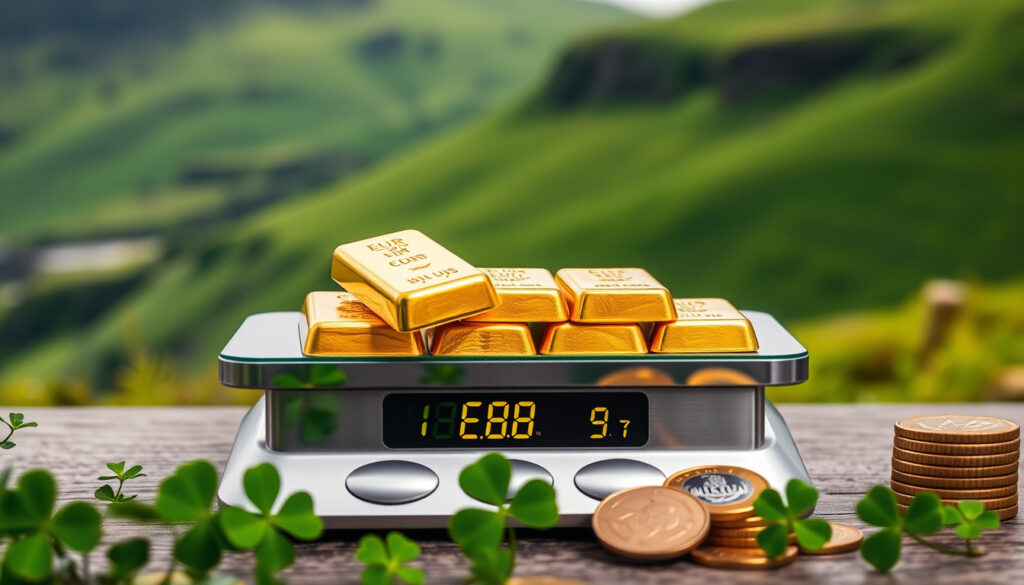
Gold Price Per Gram in Ireland: Live EUR Rates
Whether you are clearing out old jewellery or thinking about investing, knowing the gold price per gram right now makes a real difference. Prices shift throughout the day, and dealers in Ireland quote slightly different rates depending on purity, quantity, and where you buy.
24K Gold per Gram EUR: Live from BullionByPost.ie ·
Spot Gold Definition: Current market price per Cambridge Dictionary ·
9ct Gold per Gram: Scrap rate from Gold Traders ·
Gold Price Charts: Updated 24 hours from GoldPrice.org ·
Investment Return $1000: Historical growth query
Quick snapshot
- Live 24K gold rates across Irish dealers range roughly €91–€126 per gram, depending on the source and spread (GoldPricez Ireland)
- Spot gold is the wholesale interbank price that sets the benchmark for all retail investment products (GoldCore)
- Gold prices are quoted in US dollars and converted to EUR using the current EUR/USD exchange rate (GoldCore)
- Whether specific Dublin-based jewellers publish their own gram rates publicly online
- Exact thresholds where dealer spreads make buying or selling 1–5 grams unviable
- Whether the €91–€126 range reflects identical purity benchmarks across all sources
- Gold hit record highs through 2024–2025 before a modest pullback in early 2026 (BullionByPost Ireland)
- BullionByPost.ie showed a weekly change of -1.55% in recent days, indicating ongoing volatility (BullionByPost Ireland)
- Analysts have floated $5,000 per ounce targets for late 2026, though these are projections (BullionByPost Ireland)
- Live charts update every few minutes on sites like GoldPrice.org and BullionByPost.ie
- Dealers will adjust EUR gram rates as USD spot price and exchange rates move
- If gold resumes its upward trend, more Irish buyers may turn to smaller gram bars to manage cost per purchase
Four key figures define how gold is priced in Ireland at any given moment.
| Factor | Current Status | Source |
|---|---|---|
| Spot Price Basis | Per gram from live charts | GoldPrice.org |
| Ireland EUR Rate | BullionByPost.ie primary | BullionByPost Ireland |
| Sell ID Required | UK/Ireland paperwork | Industry standard (UK Gov) |
| Tax on Profits | Depends on jurisdiction per CBS | CBS News |
How much is 1 gram of gold worth today?
The short answer is that it depends on which dealer you check and what spread they apply. Across several Irish-facing bullion sites, current 24K rates cluster around two broad figures: BullionByPost.ie quoted approximately €91.44 per gram, while GoldPricez Ireland listed closer to €125.11 per gram for spot price with a bid of €123.85 and ask of €126.36 (GoldPricez Ireland). GoldPrice.org showed €126.36 with a 1-day change of -0.41 EUR (GoldPrice.org Europe).
Live 24K gold price per gram
When you buy or sell gold, the price is rarely a single figure. Dealers operate with a bid-ask spread — the price at which they will buy from you versus the price at which they will sell to you. For 5 grams of gold, GoldPricez listed a spot rate of €625.55, a buy price of €619.29, and a sell price of €631.80 (GoldPricez Ireland). That means selling back 5 grams would net you roughly €12.51 less than the spot value.
For 10 grams, the same source showed a spot of €1,251.10, a buy price of €1,238.59, and a sell price of €1,263.61. The wider the spread, the more you lose if you trade in and out quickly. Established dealers tend to have tighter spreads on larger quantities because they handle higher volumes.
Price charts last 24 hours
GoldPrice.org Europe offers a live chart updated throughout the trading day. Its current EUR per gram figure stood at €126.36 with a 1-day shift of roughly -0.41 EUR (GoldPrice.org Europe). BullionByPost Europe showed €92.03 per gram with a weekly change of -1.11% (BullionByPost Europe). The gap between these figures reflects different pricing methodologies and spread policies.
Comparing at least two dealer prices before any transaction is worth the three minutes it takes — the spread alone can represent €5–€30 on a single gram depending on where you land.
How much is 1 gram of gold in Ireland?
For buyers based in Ireland, the relevant figure is the EUR rate after exchange rate conversion. GoldCore quoted live spot price at €3,893.73 per ounce with a daily change of +0.56% (GoldCore). Dividing that per-ounce figure by 31.1035 gives roughly €125.18 per gram — consistent with the higher end of the dealer range.
Veracash listed gold price per gram at €124.38 with 24-hour EUR variation of -1.80% (Veracash), while LivePriceOfGold reported €3,869.77 per ounce, translating to approximately €124.43 per gram (LivePriceOfGold).
Gold price per gram near Dublin
Online dealers ship across Ireland regardless of your location, so geography does not directly affect the quoted EUR rate. However, if you plan to visit a physical shop in Dublin, call ahead — many bullion dealers operate by appointment, and walk-in buyers may face different terms than online customers. Smaller local jewellers typically quote based on their own sourcing costs and may not match online rates exactly.
EUR rates from GoldCore.ie
GoldCore is one of the longer-established Irish gold dealers and publishes live pricing on its website. Its spot price basis aligns with the international market, with the EUR conversion reflecting the prevailing EUR/USD rate at any given moment (GoldCore). The key takeaway is that Ireland-based buyers pay in euros but the underlying gold price is dollar-denominated — exchange rate swings add a second layer of price movement beyond the spot metal market.
If the euro weakens against the dollar, Irish buyers effectively pay more per gram even if the USD spot price stays flat — and vice versa when the euro strengthens.
What documents do I need to sell gold?
If you are selling gold jewellery, coins, or small bars in the UK or Ireland, dealers are required by anti-money laundering regulations to verify your identity before completing the transaction. This is not optional — it applies whether you are selling in person or shipping items to a dealer.
ID and paperwork in UK/Ireland
Standard identification accepted by most UK and Irish gold dealers includes a passport or driving licence. Dealers will typically record your name, address, and the ID document number. Some may ask for a utility bill or bank statement to confirm your address if it does not appear on your photo ID.
If the gold you are selling has historical receipts or a certificate of authenticity, bring those along — they can support the dealer’s assessment and may influence the price they offer. This is especially relevant for branded coins, limited-edition bars, or pieces with documented provenance.
What to bring to sell
Before you head to a dealer, gather the following: a government-issued photo ID, proof of address (if not shown on your ID), any original purchase receipts or valuation certificates, and the gold items themselves. If you are selling a large quantity — typically above a certain dealer threshold — the dealer may ask additional questions about the source of the gold.
For online transactions, most dealers will ask you to upload scanned copies of your ID and address proof before they accept a sale. Shipping is handled via tracked, insured services, and the dealer will confirm receipt and inspection before releasing payment.
Dealers who do not ask for ID are not following UK or Irish anti-money laundering requirements — steer clear, as the transaction could be flagged and your payment withheld.
What is spot gold?
The term “spot gold” refers to the current market price at which gold can be bought or sold for immediate delivery — settlement within two business days. It is set on international markets where major financial institutions trade large volumes of gold.
Spot gold definition
GoldCore describes spot gold as “the wholesale interbank price for a 400-ounce gold bar for delivery in two business days” (GoldCore). This is the benchmark price on which all retail investment gold products are based, meaning every coin, bar, or gram you might buy from a dealer is ultimately priced relative to this wholesale figure.
Relation to price per gram
The spot price is quoted per troy ounce — approximately 31.1 grams. To calculate the spot price per gram, divide the current ounce price by 31.1035. From there, dealers apply their mark-up to arrive at the retail buy price, and subtract their margin to arrive at the retail sell price. Understanding this relationship helps explain why two dealers can quote different gram rates: they may be applying different margins to the same underlying spot price.
The spot price itself is driven by global supply and demand, currency movements, economic data releases, and geopolitical events. It updates continuously during market hours, which is why live chart sites show a price that changes throughout the day rather than a single fixed figure.
The spot price you see online is the wholesale benchmark — what you actually pay or receive as a retail buyer or seller will be 2–8% higher or lower depending on the dealer’s spread policy and your transaction volume.
Do I get taxed if I sell gold?
The tax treatment of gold sales depends on where you live and the nature of the transaction. In the UK, investment gold such as gold bars and certain coins is exempt from VAT. In Ireland, the same generally applies to investment-grade gold products.
Tax on gold sales
CBS News reports that tax implications on gold sales vary by jurisdiction and depend on whether the gold is classified as an investment or a personal asset (CBS News). If you sell gold at a profit and the transaction falls within your normal tax residence rules, capital gains tax may apply on the gain.
However, some jurisdictions allow for tax-free sales up to a certain threshold, and certain gold products — particularly those held as personal jewellery rather than investment — may qualify for different treatment. The specific rules differ between the UK, Ireland, and other EU countries, so check with a local tax adviser if you are planning a significant sale.
How much tax on gold profits
There is no single answer. A small one-off sale of inherited jewellery may be treated differently from a structured sale of multiple investment bars. In the UK, capital gains tax rates and annual allowances change periodically, and your personal circumstances affect what you owe. Ireland has its own capital gains tax regime. If you are selling as part of a business activity rather than a personal investment, the profits may be subject to income tax instead.
The safest approach is to keep records of what you paid for gold and when, as well as the sale price and date. This documentation makes it straightforward to calculate any gain or loss if a tax question arises later.
Holding gold for more than a year typically improves your tax position compared to short-term flipping — but the exact benefit depends entirely on your jurisdiction and individual circumstances, so professional advice is worth the cost if the amounts are meaningful.
How to check live gold prices and sell gold
Whether you want to buy a gram bar as a starting investment or sell a piece of old jewellery, the process follows a similar pattern.
- Pick two or three dealers with publicly available live prices. BullionByPost.ie and GoldCore are established options with EUR rates; GoldPrice.org provides an independent chart aggregator.
- Check the current EUR gram rate on each site. Note the bid and ask prices, not just the headline spot figure — the spread is where your actual cost or proceeds are determined.
- Calculate your total for the quantity you are considering. For 5 grams multiply the per-gram rate by 5; for 10 grams multiply by 10. Include estimated shipping if buying online.
- Prepare your documents before initiating a sale. A valid passport or driving licence and proof of address are the minimum. Gather any original receipts or valuation certificates.
- Contact the dealer — online form, phone, or in-person — to get a confirmed price before shipping anything. Confirm whether the quote is binding for a set period or expires with market movement.
- Insure and track any items you ship. Most reputable dealers include insurance in their shipping costs for sales above a certain value. Keep the tracking number until payment clears.
What drives gold price per gram
Three forces set the price you see on any given day. The first is the USD spot price, determined on international markets and driven by global economic data, central bank policy, and investor sentiment. The second is the EUR/USD exchange rate — a weaker euro makes gold more expensive for Irish buyers even when the spot price falls. The third is the dealer’s spread, which varies based on transaction size, the dealer’s operating costs, and the purity of the gold being traded.
Lower karat items such as 9ct gold — which is 37.5% pure gold — trade at a fraction of the 24K rate. The scrap value of 9ct gold is roughly 37.5% of the current 24K gram price before dealer margins, so a gram of 9ct might trade at €35–€45 depending on the prevailing rate.
The implication: when comparing dealers, look beyond the headline spot price and check both the bid and ask — that spread is where your actual transaction cost or proceeds are determined.
What we know
- Spot gold is the wholesale
More related posts
 2026 Stat Holidays BC: Full List, Dates & Pay Rules
 15 Celsius to Fahrenheit – Exact 59°F Conversion Guide
 Water Filter System for the Whole House – Top Tested Models
 Fabric Stores Near Me – Tidewater Virginia Guide
 Has Nancy Guthrie Been Found – Latest Status and Key Updates
 Cast of That ’70s Show: Stars, Roles & Where They Are Now
 Walk In Clinic Ottawa – Top Clinics, Hours & OHIP Guide
 Les Hauts de Hurlevent: Wuthering Heights French Title Guide