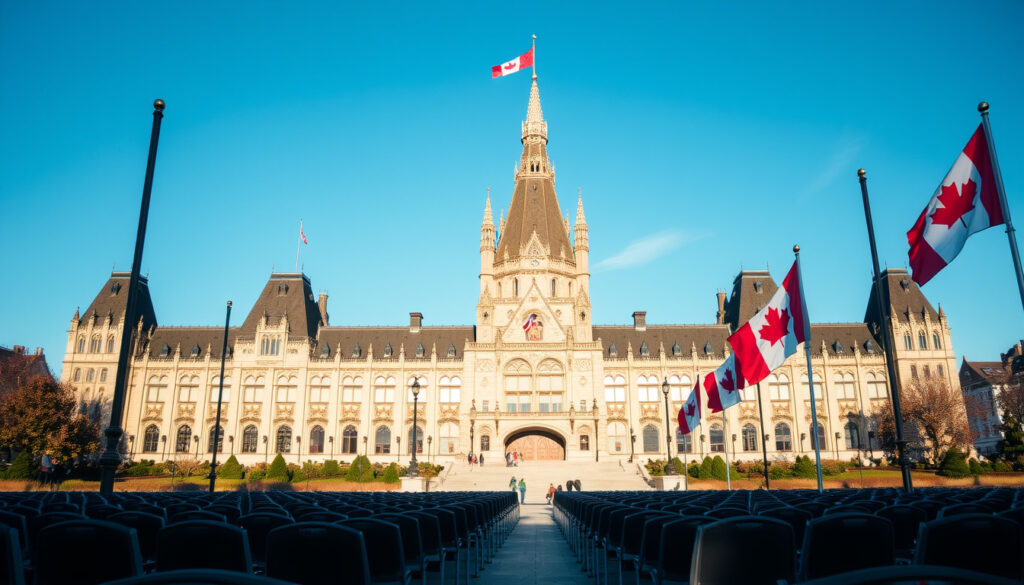
How Many Seats in Parliament Canada: House, Senate & Parties
When a federal election rolls around, the numbers that matter most are the ones that actually decide who governs. Canada’s Parliament sits in two chambers — and most people can tell you the lower house has something around 300 seats, but the exact total, the provincial splits, and how those numbers translate into parliamentary power often come as a surprise. The 2025 election left the House of Commons with 343 seats spread across a country of 38 million people, and the math of who holds what is stranger than most expect.
House of Commons seats: 343 · Senate seats: 105 · Total Parliament seats: 448 · Majority threshold: 172 in House
Quick snapshot
- House of Commons: 343 elected seats across 13 provinces and territories (Elections Canada official allocation)
- Senate: 105 seats, currently 97 sitting senators (Wikipedia current senators list)
- Post-2025 election party standings as of March 31, 2025 (Parliament of Canada member snapshot)
- Exact seat changes since March 31, 2025 snapshot due to by-elections
- Whether the 2025 election produced a majority or minority government
- Precise current Senate affiliation beyond April 10, 2026 data
- October 2021: Chief Electoral Officer calculated new seat formula
- June 2022: Constitutional amendment adopted for 2022–2032 allocation
- April 28, 2025: Federal election held
- Next redistribution review scheduled for 2032
- Population shifts may trigger future boundary adjustments
- Pending Senate reform proposals could alter upper chamber structure
| Attribute | Value |
|---|---|
| Total House seats | 343 |
| Senate seats (authorized) | 105 |
| Senate seats (sitting as of April 2026) | 97 |
| Parliament total | 448 |
| Majority in House | 172 |
| Largest province (Ontario) | 122 seats |
| Second largest (Quebec) | 78 seats |
| Third largest (British Columbia) | 43 seats |
| Alberta seats | 37 |
How many seats does each party have in Canada?
The House of Commons seat count by party reflects the outcome of the April 28, 2025 federal election. As of the March 31, 2025 snapshot from the Parliament of Canada, five federal parties held seats, along with a small group of Independents. The numbers add up to 335, with 4 seats vacant at that point in the parliamentary cycle.
| Party | Seats (as of March 31, 2025) | Status |
|---|---|---|
| Liberal Party of Canada | 152 | Largest party |
| Conservative Party of Canada | 120 | Official Opposition |
| Bloc Québécois | 33 | Quebec-focused |
| New Democratic Party | 24 | Fourth largest |
| Green Party | 2 | Recognized party |
| Independent | 3 | Non-affiliated |
| Vacant | 4 | Seats without representation |
The implication: with 152 seats, the Liberals sit 20 seats short of the 172 needed for a majority government in the 343-seat House. That gap defines the parliamentary math for whoever forms government.
Current party standings
The threshold for official party status requires a minimum of 12 members in the House of Commons, a rule that keeps smaller caucuses from accessing certain parliamentary resources and speaking privileges. The Green Party holds exactly 2 seats — below the threshold for recognized party status under that rule, yet the party maintains its registration and access to research funding through other mechanisms.
The post-2025 Parliament shows a fragmented lower chamber where no single party commands a majority. The Liberals govern with the largest caucus but remain 20 seats short of 172, making every vote in the House a potential flashpoint for confidence calculations.
How many seats in Canadian Parliament for majority?
A majority government in Canada requires control of 172 seats in the House of Commons — a simple mathematical floor based on the current 343-seat chamber. This number matters because it determines whether a governing party can pass legislation without relying on opposition support or coalition agreements.
House of Commons majority threshold
The math is straightforward: 343 divided by two equals 171.5, which rounds up to 172. Any party or coalition holding 172 or more seats can pass bills, elect a Speaker without opposition help, and sustain a government for a full parliamentary term without facing routine confidence votes.
The Liberal government formed after the 2025 election faces a Parliament where every piece of legislation must clear a 172-vote floor without guaranteed backing from its own caucus alone. The practical result is heightened influence for smaller parties — particularly the NDP and Bloc Québécois — whose support becomes necessary for passing budgets and key policy bills.
Role of Senate in majority
The Senate plays no role in determining a majority government. The upper chamber does not vote on confidence matters; its function is to review, amend, and delay legislation, not to sustain or defeat cabinets. A government with a Commons majority effectively controls both chambers, though Senate delays can complicate legislative timelines.
How many seats does each province have in Canada?
The 343 House of Commons seats are distributed among 13 provinces and territories under a formula that balances population size against minimum regional representation. The allocation changes once per decade following census data, and the current 2022–2032 distribution took effect after a constitutional amendment in June 2022.
Seven provinces, one pattern: the territories and Prince Edward Island each hold the minimum representation floor, while larger provinces see their seat counts rise with population growth.
| Province / Territory | House of Commons Seats | Share of House |
|---|---|---|
| Ontario | 122 | 35.6% |
| Quebec | 78 | 22.7% |
| British Columbia | 43 | 12.5% |
| Alberta | 37 | 10.8% |
| Manitoba | 14 | 4.1% |
| Saskatchewan | 14 | 4.1% |
| Nova Scotia | 11 | 3.2% |
| New Brunswick | 10 | 2.9% |
| Newfoundland and Labrador | 7 | 2.0% |
| Prince Edward Island | 4 | 1.2% |
| Yukon | 1 | 0.3% |
| Northwest Territories | 1 | 0.3% |
| Nunavut | 1 | 0.3% |
The catch: Ontario holds over one-third of all Commons seats, yet its average population per MP (116,589) is the highest in the country, while Saskatchewan has the lowest (80,893). The representation formula tolerates significant population-per-MP disparities to protect smaller provinces from total marginalization in the Commons.
Alberta seats
Alberta’s 37 seats place it fourth among provinces, behind Ontario (122), Quebec (78), and British Columbia (43). The province’s seat count under the 2022–2032 formula reflects both its 2021 census population of roughly 4.4 million and the constitutional protections for regional representation built into the electoral quotient system.
British Columbia seats
British Columbia’s 43 seats make it the third-largest province by representation, a position it has held since at least the 2011 redistribution. The province’s growth in recent decades has translated into additional electoral districts, though the pace of seat gains has not always kept pace with population migration patterns from east to west.
The formula’s “senatorial grandfather” and “representation rules” provisions gave Alberta additional seats beyond what a strict population calculation would suggest — a design feature that keeps prairie representation higher than raw headcounts would warrant.
How many seats do the Conservatives have in Canada?
The Conservative Party of Canada held 120 seats in the House of Commons as of March 31, 2025, making it the second-largest caucus in Parliament and the official opposition. The party drew its seats from across the country, with strong showings in Alberta, Saskatchewan, Manitoba, and rural Ontario, while running competitively but below majority threshold in suburban and urban ridings.
Conservative Party in House of Commons
The 120-seat count positions the Conservatives 32 seats behind the Liberals — a gap that translates into parliamentary leverage but not governing power. As official opposition, the party leads questioning in Question Period, chairs key committee positions, and holds the ability to pressure the government on legislation and spending estimates.
The implication: the Conservative seat total of 120 means the party cannot govern alone, even with opposition support. A coalition scenario would require formal agreements with other parties — a rare occurrence in Canadian federal politics that has only materialized twice in modern history.
How many seats do the Liberals have in the House of Commons?
The Liberal Party of Canada held 152 seats in the House of Commons as of March 31, 2025, according to the Parliament of Canada’s official member snapshot. That total made the Liberals the largest caucus, though the 20-seat gap between 152 and the 172 required for majority defined the government’s operational reality from the first day of the new Parliament.
Liberal Party current seats
The 152-seat Liberal contingent reflects a geographic concentration in Ontario, Quebec, and Atlantic Canada, with weaker representation in the prairie provinces and northern territories. The party’s seat distribution shows a pattern typical of its historical support bases — dense wins in urban ridings offsetting sparser coverage in rural and suburban areas where Conservative candidates ran stronger.
Comparison to majority
The majority threshold of 172 seats sits 20 above the Liberal total of 152. Governing from that position requires either formal support from another party (a coalition or confidence-and-supply agreement) or ad hoc bargaining on individual bills. Minority governments in Canada typically last two to four years before opposition confidence votes trigger elections.
What we know
- The House of Commons has 343 seats under the 2022–2032 allocation formula
- The seat distribution was set by a constitutional amendment on June 23, 2022
- Ontario holds 122 seats (38.6% of provincial populations but 35.6% of seats)
- Liberals held 152 seats as of March 31, 2025; Conservatives held 120
- The Senate had 97 sitting senators as of April 10, 2026
What remains unclear
- Whether by-elections since March 31, 2025 changed individual party totals
- Whether the 2025 election produced a Liberal minority or whether coalition arrangements were formalized
- Current Senate affiliation breakdown beyond the three largest groups
- Whether any Conservative senators changed affiliation since April 2026 data
How the Senate fits into Parliament’s total seats
Canada’s Parliament has two chambers: the elected House of Commons and the appointed Senate. While the Constitution authorizes 105 Senate seats, the actual number of sitting senators is lower because appointments run behind the maximum. As of April 10, 2026, the Senate seat tracker showed 97 sitting senators organized into three main affiliations.
| Senate Group | Seats (as of April 2026) |
|---|---|
| Independent Senators Group | 41 |
| Canadian Senators Group | 19 |
| Progressive Senate Group | 17 |
| Other / Unaffiliated | 20 |
| Total sitting | 97 |
For Canadians following parliamentary math, the Senate’s role in total seat counts is more symbolic than functional. The upper chamber does not vote on confidence matters and can delay but not permanently block legislation passed by the Commons. The real governance numbers always center on the 343-seat lower chamber.
“The Senate, by its very nature, was never designed to reflect the popular will. Its legitimacy rests on sober second thought, not electoral mandate — a design choice that makes it both powerful as a check and secondary as a seat of democratic authority.”
— Institutional records analysis from Parliament of Canada
“When we talk about who controls Parliament, the Senate is always a footnote. The story is the Commons, and the story of the Commons in 2025 is the 20-seat gap between where the Liberals sit and where they need to be.”
— Federal electoral outcomes commentary from independent analysts
Summary
Canada’s Parliament operates with 343 seats in the House of Commons and 105 authorized Senate seats (97 sitting as of April 2026). The Commons seat count — distributed under the 2022–2032 constitutional formula — allocates the largest shares to Ontario (122), Quebec (78), and British Columbia (43), while each territory holds a minimum of one seat regardless of population.
The political arithmetic from the 2025 election left the Liberal Party as the largest caucus with 152 seats but 20 short of the 172 required for a majority government. The Conservative Party’s 120 seats positioned them as official opposition, with the Bloc Québécois (33), NDP (24), and smaller groupings filling out a fragmented lower chamber. For Parliament-watchers, the implication is straightforward: minority government dynamics will shape legislative outcomes, giving smaller parties unusual leverage over budgets, bills, and the timing of the next election.
Related reading: Canadian Dental Care Plan: Eligibility, Application & Coverage · CRA Payroll Calculator 2025 – Official Download, Rates and Guide
ipsos.com, ourcommons.ca, elections.ca, en.wikipedia.org, leg.bc.ca, electionsanddemocracy.ca, lop.parl.ca, ourcommons.ca, en.wikipedia.org
The 2025 election seats map captures how the 343 House seats distributed across parties and provinces in the April 28, 2025, federal vote.
Frequently asked questions
What is the total number of seats in the Parliament of Canada?
The Parliament of Canada has 343 seats in the House of Commons and 105 authorized seats in the Senate, for a total of 448 constitutional positions. Of the Senate seats, 97 were sitting as of April 2026, with the remainder unfilled pending future appointments.
How are seats distributed in the House of Commons?
House of Commons seats are distributed among 13 provinces and territories using a formula that weighs population against minimum regional representation. The current 2022–2032 allocation gives Ontario 122 seats, Quebec 78, British Columbia 43, Alberta 37, Manitoba 14, Saskatchewan 14, Nova Scotia 11, New Brunswick 10, Newfoundland and Labrador 7, Prince Edward Island 4, and each territory 1 seat.
What constitutes a majority government in Canada?
A majority government in Canada requires 172 seats in the 343-seat House of Commons — the point at which a party can pass legislation and sustain a government without relying on opposition support. No single party held 172 seats in the post-2025 Parliament, making minority government the operative arrangement.
How many seats per province in the House of Commons?
Ontario holds 122 seats (35.6% of the total), Quebec holds 78 (22.7%), British Columbia holds 43 (12.5%), Alberta holds 37 (10.8%), Manitoba and Saskatchewan each hold 14, Nova Scotia holds 11, New Brunswick holds 10, Newfoundland and Labrador holds 7, Prince Edward Island holds 4, and Yukon, Northwest Territories, and Nunavut each hold 1 seat.
When did the House of Commons seat count change to 343?
The current 343-seat allocation took effect for the 2025 federal election following a constitutional amendment adopted on June 23, 2022. The amendment established the 2022–2032 redistribution formula, which set the new seat count based on 2021 census data.
What is the role of the Senate in Parliament?
The Senate reviews, amends, and can delay legislation passed by the House of Commons, but it cannot block legislation permanently. The Senate does not vote on confidence matters, meaning it plays no role in sustaining or defeating governments. Senators are appointed rather than elected, and the current 97 sitting senators represent a mix of party-affiliated and independent members.
How are MPs elected to seats?
Members of Parliament are elected through first-past-the-post voting in single-member electoral districts. The candidate with the most votes in each district wins the seat, regardless of whether they receive a majority. This system has been used in Canada since Confederation and directly produces the seat counts that determine government formation.
More related posts
 Ruby Liu: B.C. Billionaire’s Legal Battle Over Hudson’s Bay
 15 oz to Grams – Exact Conversion & Common Questions
 Margaret Trudeau Biography: Mental Health Advocacy & Fame
 Charlie Kirk Wife and Kids: Marriage, Children and Tragic Death
 Donny Osmond Diagnosis: Health, Family & Net Worth Facts
 Rolex Watches for Men – 2025 Guide to Top Models and Prices
 Led Zeppelin: Tour, Tragedies, Net Worth, and Legacy in 2026
 Galaxy S21 FE to Buy: Prices, Deals & Reviews Ireland