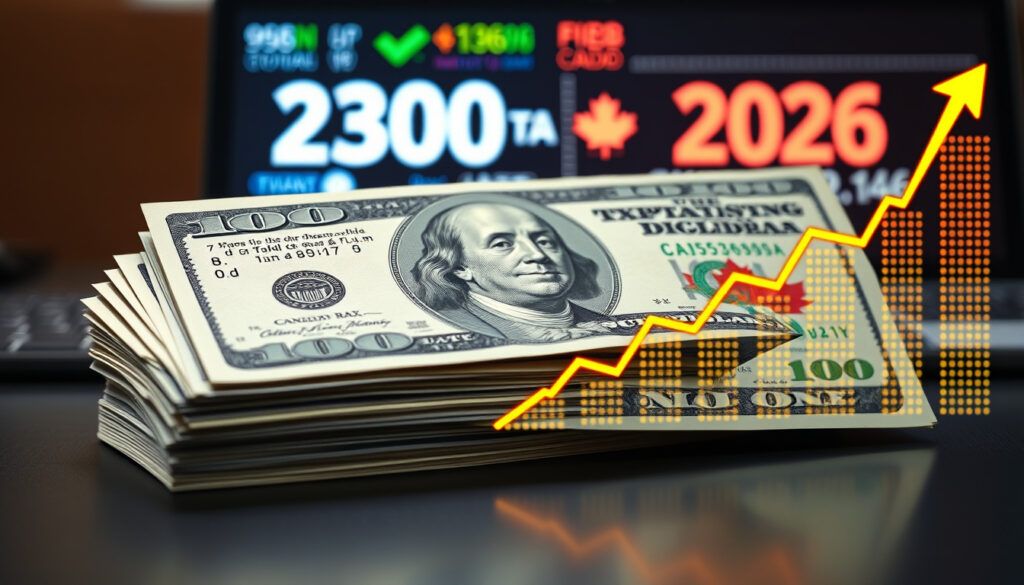
2300 USD to CAD: Live Converter, Rates & 2026 Forecasts
If you’ve ever tried to move money between the US and Canada, you know that the exchange rate isn’t just a number — it’s the difference between dollars gained or lost in transit. Right now, the USD/CAD pair is doing something that has analysts watching closely: the Canadian dollar is showing quiet strength, and forecasts from major banks suggest that trend could hold through 2026. That matters if you’re converting $2,300 today or planning ahead.
Current Rate: 1 USD = 1.357 CAD · 2300 USD Value: 3,121.68 CAD · Forecast Level: 1.3700 CAD per USD
Quick snapshot
- Rate at 1.357–1.365 CAD/USD (mid-April 2026) — LiteFinance
- 2300 USD = ~3,121–3,169 CAD depending on provider — CurrencyTransfer
- 5-bank consensus pegs CAD strength through 2026 — Interchange Financial
- Transfers settle in 1–2 business days — CurrencyTransfer
- Exact rate at moment of your transaction
- Which direction the pair breaks if oil pivots
- Whether mid-year weakness (forecasted by some) persists
- April 11, 2026: USD/CAD = 1.3838 — LongForecast
- April 17, 2026: USD/CAD = 1.36554 — LiteFinance
- National Bank Q3 2026: 1.38 · Q4 2026: 1.35 — National Bank
- RBC targets 1.3400 by end-2026 — CanAm Currency Exchange
- Scotiabank sees CAD/USD at 0.75 (~1.333 USD/CAD) — Interchange Financial
- ING projects 0.746 (~1.340 USD/CAD) — Interchange Financial
How much is $1 US in CAD?
The current mid-market rate sits around 1.357 to 1.365 Canadian dollars per US dollar, according to real-time tracking data from LiteFinance (financial analysis platform) as of mid-April 2026. That means every US dollar buys roughly $1.36 Canadian — a rate that has the Canadian dollar hovering near the stronger end of its 2026 trading range.
To put that in perspective: if you were converting $1,000 USD today, you’d receive approximately $1,357 CAD using the CashBackForexUSA rate, or up to $1,377 CAD at the MyFin rate.
Live exchange rate
Real-time rates shift throughout the trading day. On April 11, 2026, the pair hit 1.3838 (a weaker Canadian dollar), then moved to 1.36554 by April 17, 2026, according to LiteFinance and LongForecast (historical data tracker). The 14-day RSI sitting at 33.67 — a neutral reading — suggests no extreme overbought or oversold pressure, according to CoinCodex (forex forecast platform).
Historical chart
Looking at the broader picture, USD/CAD has traded in a band roughly between 1.34 and 1.44 through 2026, with 30-day volatility at just 0.60%, as noted by CoinCodex. That relatively tight range is part of why analysts are watching for a breakout — whether upward toward the stronger CAD levels or a pullback.
How much is $2000 USD to CAD?
For a $2,000 USD transfer, rates around 1.370 yield approximately 2,740 CAD, based on CurrencyTransfer (transfer platform) data. Scaling that same rate to 2,300 USD gives you roughly 3,151 CAD — though the exact figure depends on which provider you use.
The gap between providers is real: at 1.357 you get 3,121.675 CAD; at 1.377 you receive 3,169.17 CAD. That’s roughly a $47 difference on $2,300. Over multiple transfers, that adds up.
Transfer providers like Wise (fee-transparent transfer service) regularly beat bank rates by up to 3% on CAD transfers. For $2,300, that could mean an extra $70 CAD in your pocket versus a traditional bank exchange.
Conversion for 2000 USD
Using the mid-market rate of approximately 1.37, converting $2,000 USD yields around 2,740 CAD. Transfer times typically run 1–2 business days, according to CurrencyTransfer.
Similar amounts like 2300 USD
Applying the same 1.37 rate: 2,300 × 1.37 = 3,151 CAD. At the slightly higher 1.377 rate, you get 3,169.17 CAD. At the more conservative 1.357 rate, the conversion lands at 3,121.675 CAD. These variations illustrate why comparing two to three providers before transferring is worth the effort.
What is $25,000 USD in CAD?
At 1.357 CAD/USD, $25,000 USD converts to roughly 33,925 CAD. At 1.377, you’re looking at 34,425 CAD. That’s a $500 spread on a larger transfer — significant for businesses or individuals moving substantial amounts across the border.
For context, if you’re converting $25,000 through a bank rather than a specialist platform, you might pay a 2–3% spread. On $25,000, that’s $500–$750 in hidden fees, according to fee analysis from Wise.
Large amount conversion
When moving five figures or more, even a 0.01-point difference in the exchange rate matters. Platforms like CurrencyTransfer show live rates with no hidden markup, giving you the actual mid-market rate minus a small transfer fee.
Live rate via Instarem
Orbit Money (Canada-focused transfer guide) notes that specialized platforms often offer rates 1–3% better than Canadian banks for USD-to-CAD transfers. For a $25,000 conversion, that translates to $250–$750 CAD saved.
Why is CAD getting stronger than USD?
Several factors are driving the Canadian dollar’s relative strength in 2026 forecasts. Major bank analysts — including Scotiabank, ING, and National Bank — all project CAD strengthening against the greenback through year-end, per Interchange Financial (bank forecast aggregator).
Scotiabank expects the CAD/USD pair to reach 0.75 by late 2026 — meaning one Canadian dollar buys 75 US cents, or conversely, one US dollar buys approximately 1.333 Canadian dollars. ING projects a similar path to 0.746 (~1.340 USD/CAD), according to Interchange Financial.
Current factors
Bank of Canada policy, commodity prices (particularly oil, Canada’s largest export), and interest rate differentials all influence the pair. With Canada’s inflation trajectory and interest rate environment showing signs of stabilization, the Bank of Canada’s stance has been relatively supportive of CAD strength, analysts note.
Recent trends
The pair has moved from 1.3838 on April 11 to 1.36554 by April 17, 2026 — a 1.3% shift in less than a week. That movement reflects ongoing adjustment to evolving policy signals from both the Bank of Canada and the US Federal Reserve.
Is CAD going to get stronger?
The five-bank consensus suggests yes — with caveats. National Bank (Canadian Tier-1 bank forecaster) projects Q3 2026 at 1.38, then Q4 2026 at 1.35 — implying the Canadian dollar strengthens from current levels. CanAm Currency Exchange (currency exchange specialist) compiles these forecasts alongside RBC Capital Markets’ target of ~1.3400 for end-2026.
Not every forecast agrees: CoinCodex forecasts the pair at 1.31 by end-2026, which would represent a notable CAD strengthening from today’s levels, according to CoinCodex. ExchangeRates.org.uk forecasts 1.3518 by December 2026, close to National Bank’s Q4 view.
Forecasts cluster around 1.33–1.38 by year-end, but a wide spread exists from 1.31 to 1.41. Traders Union forecasts 1.3742, while LongForecast puts May 2026 at 1.410. No two analysts agree exactly — which is why a range matters more than a single point estimate.
2026 forecasts
- RBC Capital Markets: 1.3400 (end-2026)
- National Bank: 1.35 (Q4 2026)
- Scotiabank: 1.333 (~0.75 CAD/USD)
- ING: 1.340 (~0.746 CAD/USD)
- CoinCodex: 1.31 (end-2026)
- Traders Union: 1.3742
5-bank predictions
Five major institutions have published USD/CAD year-end 2026 targets. The spread runs from CoinCodex’s bearish 1.31 to LongForecast’s more bullish 1.41, but the consensus sits between 1.33 and 1.38. For someone converting $2,300 today and expecting CAD to strengthen, that range suggests modest upside — but no guarantee of dramatic moves.
Step-by-step: How to convert USD to CAD at the best rate
Three steps separate you from a better-than-bank rate on your $2,300 conversion.
- Compare rates before committing. Use a platform like CurrencyTransfer or check Wise to see the mid-market rate. A bank may offer 1.34 while a specialist platform offers 1.37 — that gap is pure savings.
- Lock in your rate if the platform supports it. Many transfer services let you hold a rate for 24–48 hours while you fund the transfer. With USD/CAD volatility at just 0.60% over 30 days (per CoinCodex), short-term timing is less critical — but if you see a rate you like, grab it.
- Verify total cost. Some providers advertise a great rate but layer on fees. Wise publishes its fee upfront; bank fees are often embedded in the spread. For a $2,300 transfer, a 1% hidden fee costs $23 CAD — easy to avoid with comparison.
Specialist platforms typically take 1–2 business days to settle. If you need CAD immediately, a bank branch or currency exchange counter can deliver on the spot — but at a worse rate. For $2,300, the rate difference often outweighs a day’s wait.
Clarity on what’s confirmed and what remains uncertain
Confirmed
- USD/CAD rate on April 11, 2026: 1.3838
- USD/CAD rate on April 17, 2026: 1.36554
- Bank transfer times: 1–2 business days
- 5-bank consensus for CAD strengthening in 2026
- Wise offers rates up to 3% better than banks
Unclear
- Exact rate at moment of your transaction
- Whether mid-year weakness forecasts materialize
- Which direction the pair breaks if oil prices shift
- How Fed policy changes affect year-end forecasts
What analysts are saying
USD to CAD exchange rate is forecasted to hit $1.31 by the end of 2026 (-4.58% compared to current rates).
— CoinCodex (forex forecast platform)
Scotiabank expects CAD/USD to move toward 0.75 by late 2026, implying a USD/CAD rate around 1.333 — a modest but notable CAD strengthening from current levels.
— Interchange Financial (compiling Scotiabank analysis)
ING projects the Canadian dollar near 0.746 by year-end 2026 (~1.340 USD/CAD), broadly aligned with National Bank’s Q4 forecast of 1.35.
— Interchange Financial (compiling ING analysis)
RBC Capital Markets targets ~1.3400 end-2026, with CAD strengthening modestly through the year as monetary policy divergence narrows.
— CanAm Currency Exchange (aggregating RBC analysis)
USD/CAD timeline: Where the pair has been and where it’s heading
Three snapshots define the trajectory in 2026.
| Period | Rate | Source |
|---|---|---|
| April 11, 2026 | 1.3838 | LongForecast |
| April 17, 2026 | 1.36554 | LiteFinance |
| May 2026 (forecasted) | 1.410 | LongForecast |
| May 2026 (forecasted) | 1.3645 | ExchangeRates.org.uk |
| September 2026 (forecasted) | 1.3518 | ExchangeRates.org.uk |
| Q3 2026 (forecasted) | 1.38 | National Bank |
| Q4 2026 (forecasted) | 1.35 | National Bank |
| End-2026 (consensus) | 1.33–1.38 | 5-bank average |
The pattern suggests near-term volatility between now and mid-year, with a gradual drift toward a stronger CAD by Q4 2026. Note that LongForecast calls for a spike to 1.410 in May 2026 before the pair settles — an outlier that some analysts attribute to seasonal commodity demand shifts.
Related reading: CAD to US Dollar – Current Rate April 1 2026
Amid 2026 forecasts, tools like the 2200 USD to CAD guide offer live rates for the closely comparable 2200 USD conversion.
Frequently asked questions
What is the current USD to CAD exchange rate?
As of mid-April 2026, the USD/CAD rate sits around 1.36554 per LiteFinance. Rates vary slightly between providers, from 1.357 to 1.377, depending on the platform you use.
How do I get the best rate for 2300 USD to CAD?
Use a specialist transfer platform like Wise or CurrencyTransfer rather than a bank. These platforms often offer rates 2–3% better than traditional banks. For $2,300, that difference can mean $60–$70 CAD extra in your pocket.
What factors affect USD/CAD rates?
Bank of Canada monetary policy, US Federal Reserve decisions, oil prices (Canada’s largest export), interest rate differentials, and broader economic growth data all influence the pair. With both central banks navigating post-pandemic adjustments, short-term volatility is expected.
How to convert USD to CAD without banks?
Transfer platforms like CurrencyTransfer, Wise, or peer-to-peer exchange services allow you to convert USD to CAD at mid-market rates minus a small fee. Transfers typically settle in 1–2 business days.
What is the historical USD/CAD trend?
Over the past five years, USD/CAD has traded between roughly 1.20 and 1.45. In 2026, the pair has held a tighter range of 1.34–1.44 with 30-day volatility at just 0.60% — relatively calm compared to prior years. Historical data is available from platforms like LongForecast.
Should I convert 2300 USD to CAD now?
If you need CAD within the next 1–2 weeks, locking in a rate now (around 1.36–1.37) is reasonable. Five-bank forecasts suggest CAD will strengthen to ~1.33–1.38 by year-end, which means waiting might yield a slightly better rate — but the spread between now and year-end is modest (0.02–0.05 points). For larger amounts, monitoring the pair for a break above 1.38 before converting makes sense.
What is CAD to USD for 1000 CAD?
At 1.357 USD/CAD, 1,000 CAD converts to approximately $736 USD. At 1.377, it’s roughly $725 USD. The inverse rate (CAD to USD) depends on which direction you’re converting, and the spread between buy and sell rates affects the final amount.
For US-based readers converting $2,300 to Canadian dollars, the choice is straightforward: use a fee-transparent platform, compare two to three rates, and if the transfer isn’t urgent, keep an eye on the pair through mid-2026 for a potentially better rate. The difference between a 1.357 rate and a 1.377 rate — roughly $47 CAD — is worth five minutes of comparison shopping.
| Source | Rate Used | 2300 USD in CAD |
|---|---|---|
| CashBackForexUSA | 1.357 | 3,121.675 CAD |
| MyFin | 1.377 | 3,169.17 CAD |
| USD Currency Rate Today | 1.373 | 3,158.31 CAD |
| CoinCodex (mid-market) | ~1.37 | ~3,151 CAD |
| CurrencyTransfer | ~1.370 | 3,151 CAD |
| LongForecast (May 2026) | 1.410 | 3,243 CAD |
These provider rates illustrate the real cost of converting $2,300 USD to CAD — the difference between the lowest and highest quoted rate adds up to roughly $121 CAD over a year of transfers.
| Provider | Rate Type | Best For | Key Feature |
|---|---|---|---|
| Wise | Mid-market + low fee | Small-to-medium transfers | Transparent pricing, no margin markup |
| CurrencyTransfer | Live competitive rate | USD to CAD transfers | Rate comparison across providers |
| CashBackForexUSA | Aggregated rate | Quick conversion check | Multiple source comparison |
| Traditional Bank | Bank-set rate | Large corporate transfers | Established relationship, higher fees |
Choosing a provider isn’t just about the rate — transfer speed, fee structure, and reliability matter for amounts like $2,300.
More related posts
 RoboCop Remake Scene 27 – Tactical Raid Breakdown
 Che Ba Mau Near Me: Best Spots, Menus, Prices & Delivery
 6000 CAD to INR – Current Exchange Rate and Conversion Guide
 Hard Rock Riviera Maya – Adults-Only All-Inclusive Resort Guide
 John C. McGinley: Real Name, Family, Scrubs Reboot & Advocacy
 Miles Teller Movies: The Best Films and Filmography
 SSC Napoli vs Cagliari Calcio Lineups: Title-Winning Clash
 Where Is Justin Trudeau Today Now – What We Know in 2026