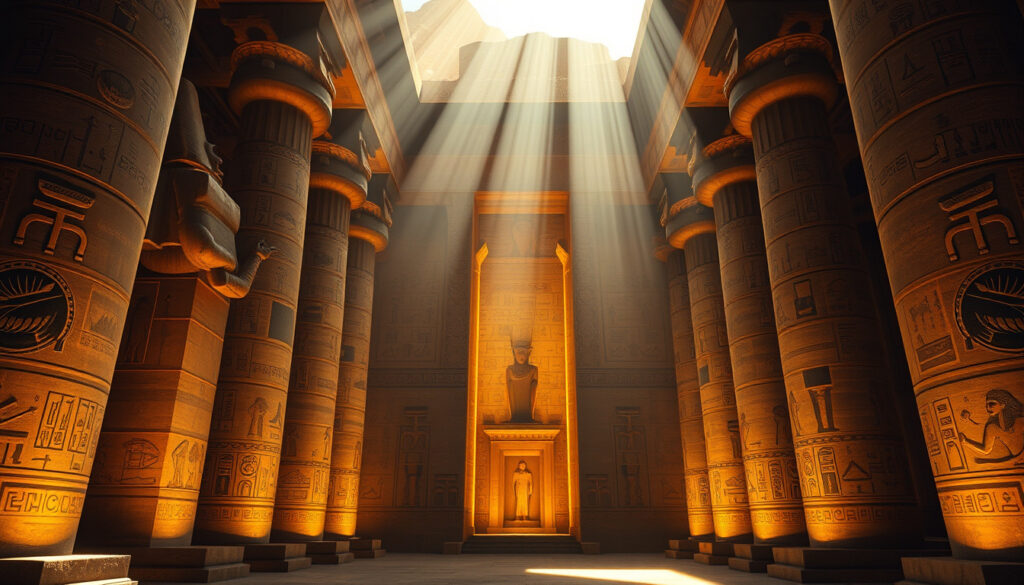
Egyptian Gods: Ennead, Deities, Powers & More
Ever wondered why ancient Egyptians had so many gods? The answer lies in a complex pantheon that evolved over 3,000 years, with the Great Ennead of Heliopolis forming the core creation narrative. Here we’ll sort through the different groupings — from the nine gods of the Ennead to the popular lists of twelve — and show you what’s actually verifiable from historical sources.
Major Egyptian deities: 9 (Ennead of Heliopolis) ·
Total known gods and goddesses in ancient Egypt: over 2,000 ·
Period of worship: over 3,000 years ·
First recorded deity: Ra (solar god) ·
Most prominent goddess: Isis ·
God of the afterlife: Osiris
Quick snapshot
- The Great Ennead includes Atum, Shu, Tefnut, Geb, Nut, Osiris, Isis, Seth, Nephthys (Britannica (encyclopedia))
- Egyptians worshipped over 2,000 deities (Wikipedia (online encyclopedia))
- No single authoritative list of 12 main gods exists (Britannica (encyclopedia))
- Whether Horus the Elder or Horus son of Isis is included in some lists is ambiguous (Britannica (encyclopedia))
- c. 3100 BCE: Early dynastic period, formation of major deity cults (Wikipedia (history of religion))
- c. 2500 BCE: Heliopolis Ennead documented (Britannica (encyclopedia))
- Modern scholarship continues to refine the lists based on temple inscriptions (Global Egyptian Museum (museum glossary))
- The Ennead remains the most cited grouping in popular culture (Global Egyptian Museum (museum glossary))
| Attribute | Value |
|---|---|
| Total number of Egyptian gods | Over 2,000 known |
| Most important group | The Ennead (9) |
| God of the dead | Osiris |
| Sun god | Ra |
| Magic goddess | Isis |
| God of writing | Thoth |
| God of war and chaos | Seth |
| Falcon-headed sky god | Horus |
Who are the 9 major Egyptian gods?
The Ennead of Heliopolis
The Great Ennead of Heliopolis is a group of nine deities central to Egyptian creation mythology. According to the Britannica (encyclopedia), the standard ordering is: Atum, Shu, Tefnut, Geb, Nut, Osiris, Isis, Seth, and Nephthys. The Global Egyptian Museum (museum glossary) confirms this sequence, noting that Atum is the creator and sun god at the head of the Ennead, with Shu and Tefnut as his children, and Geb and Nut as the next generation.
This grouping represents a creation genealogy, not just a list of unrelated gods. Shu and Tefnut are the air/moisture pair, while Geb and Nut represent earth and sky. Their children — Osiris, Isis, Seth, and Nephthys — form the final generation. The Wikipedia (online encyclopedia) entry on the Ennead gives the same nine members, emphasizing the Heliopolitan theology rather than a universal pan-Egyptian fixed canon.
The Ennead is a dynastic model: three generational pairs (Atum, Shu/Tefnut, Geb/Nut) plus a sibling set (Osiris, Isis, Seth, Nephthys). This structure mirrors the Egyptian view of divine succession.
Variations of the nine
Some lists replace Atum with Re or Re-Atum, as the sun god was central to the Heliopolitan cult. The Britannica (encyclopedia) notes that the Ennead was “headed by the sun god and creator Re or Re-Atum.” Additionally, the Global Egyptian Museum (museum glossary) mentions a “Small Ennead of Heliopolis” that included Horus, Anubis, Maat, and Thoth — a later expansion of the original nine.
The implication: the list of nine was not rigid. Different cities and time periods adapted the grouping to emphasize their own patron deities.
What are the 12 main gods of Egypt?
Common list of twelve gods
A frequently cited list of twelve major Egyptian gods includes: Ra, Amun, Osiris, Isis, Horus, Seth, Ptah, Hathor, Anubis, Thoth, Bastet, and Sobek. However, the Britannica (encyclopedia) states that no single authoritative list of 12 exists — this grouping is a modern compilation, loosely inspired by the Greek Olympian tradition. The Wikipedia (list of Egyptian deities) includes hundreds of entries, none of which are formally grouped as “the 12 main gods.”
Eight of these twelve names overlap with the Ennead or the Small Ennead: Ra (Atum), Osiris, Isis, Horus, Seth, Ptah, Hathor, and Thoth. Anubis, Bastet, and Sobek were added from regional cults. This highlights the challenge of pinning down a fixed pantheon.
The “12 main gods” is a popular list, not an ancient canon. No temple inscription or papyrus ever enumerated exactly twelve deities as the chief pantheon.
Alternative groupings
Some sources list a different set of twelve, including Maat, Mut, Khonsu, or Montu depending on the region. The Kiddle (educational encyclopedia) emphasizes that the Heliopolitan theology was one of several local theologies, and other cities like Thebes and Memphis had their own pantheons. Thebes, for example, promoted the triad of Amun, Mut, and Khonsu. Memphis had Ptah, Sekhmet, and Nefertem.
The trade-off: any list of 12 is a compromise between the Ennead tradition and the need to include popular deities from later periods.
Who were the 10 gods of Egypt?
Regional pantheon variations
The number 10 appears in some modern lists, usually by taking the 12 gods and removing two of the least prominent. A common set of ten includes: Ra, Amun, Osiris, Isis, Horus, Seth, Ptah, Hathor, Anubis, Thoth. This is essentially the 12 list minus Bastet and Sobek. The Britannica (encyclopedia) does not recognize a “ten” group, but the overlap with the Ennead and Small Ennead is clear.
Common ten
Another source, the Malevus (history website), lists ten deities including Osiris, Isis, Horus, Seth, Ptah, Re, Hathor, Anubis, Thoth, and Maat. This adds Maat (goddess of truth) and replaces Amun with Re. The variation shows that the “ten” is a flexible category, often used to simplify the 12 for classroom or tourism purposes.
The pattern: the difference between 10, 12, and 9 is mostly about which regional or late-added deities are included. The core of Osiris, Isis, Horus, Seth, and Ra remains constant.
Who are the five Egyptian gods?
Children of Nut and Geb
The five gods most central to the Osiris myth cycle are: Osiris, Isis, Seth, Nephthys, and Horus. According to the Global Egyptian Museum (museum glossary), Osiris, Isis, Nephthys, and Seth are the children of Geb and Nut. Horus (the younger) is the son of Osiris and Isis. This family narrative is the core of Egyptian mythology: Osiris killed by his brother Seth, resurrected by Isis, and avenged by his son Horus.
Role in the Osiris myth
These five gods are not a formal grouping like the Ennead, but they are the principal actors in the most famous Egyptian myth. The Britannica (encyclopedia) describes Osiris as the ruler of the dead, Isis as the protective goddess of magic, Seth as the god of chaos, and Horus as the falcon-headed sky god and protector of pharaohs. Nephthys is the protective goddess of the dead, often shown with Isis.
Why this matters: the five-god list is the only grouping that directly corresponds to a single narrative — the Osiris cycle. It’s not a pantheon but a dynastic drama.
Egyptian gods and their powers
Major gods and domains
Each major god had a specific domain and power. The table below compares the main deities across the different group lists.
Ten deities, one pattern: the same gods appear in almost every list, but their rankings shift with geography and time.
| God | Domain | Appears in Ennead | Appears in 12 | Appears in 5 |
|---|---|---|---|---|
| Ra / Atum | Sun, creation | Yes | Yes | No |
| Osiris | Afterlife, resurrection | Yes | Yes | Yes |
| Isis | Magic, healing, motherhood | Yes | Yes | Yes |
| Horus | Sky, war, kingship | No (Small Ennead) | Yes | Yes |
| Seth | Chaos, storms, desert | Yes | Yes | Yes |
| Ptah | Crafts, creation (Memphite) | No | Yes | No |
| Hathor | Love, music, motherhood | No | Yes | No |
| Anubis | Mummification, afterlife | No (Small Ennead) | Yes | No |
| Thoth | Writing, wisdom, moon | No (Small Ennead) | Yes | No |
| Bastet | Home, protection, cats | No | Yes | No |
Powers of Ra, Isis, Osiris
Ra (or Re) was the sun god, controlling sun, creation, and kingship. The Britannica (encyclopedia) describes him as the supreme deity who created the world from the primordial waters. Isis was the goddess of magic and healing, known for her cunning in resurrecting Osiris. Osiris ruled the afterlife and judged the dead, as detailed by the Britannica (encyclopedia). These three formed the most powerful triad in Egyptian religion.
Ra, Isis, and Osiris appear in every major grouping. Their powers define the Egyptian worldview: creation (Ra), resurrection (Isis), and judgment (Osiris).
Confirmed facts vs. what’s unclear
Confirmed facts
- The Great Ennead includes Atum, Shu, Tefnut, Geb, Nut, Osiris, Isis, Seth, Nephthys (Britannica, Global Egyptian Museum)
- Egyptians had over 2,000 deities (Wikipedia)
- Osiris is the god of the dead and ruler of the underworld (Britannica)
What’s unclear
- The exact list of 12 main gods is not consistent across sources (Britannica)
- Whether Horus the Elder or Horus son of Isis is included in some lists
- If the Small Ennead is a later addition or a separate tradition (Global Egyptian Museum)
Key perspectives from experts
Horus was the god of the sky, war, hunting, and kingship. He was the protector of the pharaoh, who was considered the living Horus.
Britannica lists 11 Egyptian gods and goddesses including Osiris, Isis, Horus, Seth, Ptah, Re, Hathor, Anubis, and Thoth, noting that the list is not exhaustive.
— Britannica (encyclopedia)
Wikipedia’s list of Egyptian deities contains hundreds of entries, from the well-known gods of the Ennead to minor local spirits.
— Wikipedia (list of Egyptian deities)
Summary
The different numbers of Egyptian gods — 9, 12, 10, 5 — are not contradictory but reflect different historical contexts. The Ennead is the most canonical, tied to the Heliopolis creation myth. The 12 and 10 lists are modern compilations that include popular deities from later periods. The 5 gods are the direct actors in the Osiris myth. For anyone researching ancient Egyptian religion, the lesson is clear: always check the source and the regional context before accepting a list as definitive. The pantheon was fluid, and that fluidity is the key to understanding how the Egyptians themselves saw their gods.
Related reading: Joseph Stalin: Biography, Legacy, and Controversies · Pope John Paul II: Biography, Papacy, Teachings, and Legacy
study.com, egyptmythology.com, facebook.com, theennead.fandom.com, marvel.com, ancient-egypt-online.com, youtube.com, youtube.com
For a more detailed breakdown of each deity along with their symbols and visual depictions, see this complete list of Egyptian gods.
Frequently asked questions
Why do different lists of Egyptian gods exist?
Different cities and time periods had their own patron deities and theologies. The Ennead of Heliopolis was one local creation myth, while Thebes, Memphis, and other centers promoted their own pantheons. Modern lists often combine these traditions.
Was Anubis a major Egyptian god?
Anubis was a major god of mummification and the afterlife, but he was not part of the original Ennead. He appears in the Small Ennead and is commonly included in modern lists of 12 or 10 gods.
Did the Egyptians worship only nine gods?
No. The Ennead is a specific theological grouping from Heliopolis. The Egyptians worshipped hundreds of deities, including local gods, household gods, and state gods. The nine were the most important in that particular creation myth.
How were Egyptian gods organized?
Gods were often organized into families, triads (father, mother, child), or enneads (groups of nine). Cities had their own local pantheons. The state religion promoted certain gods like Amun-Ra during the New Kingdom.
What is the difference between the Ennead and the Ogdoad?
The Ogdoad was a group of eight primordial gods from Hermopolis, representing chaos before creation. The Ennead is the nine gods of Heliopolis that represent the ordered creation. They are different creation myths from different cities.
Who was the most powerful Egyptian god?
Ra (or Amun-Ra during the New Kingdom) was considered the supreme creator and king of the gods. Osiris ruled the afterlife, and Isis was the most powerful goddess due to her magic. Power depended on the region and period.
More related posts
 Jackie Robinson: Facts, Legacy, and Why He Matters
 Kevin Costner Movies and TV Shows: Full Filmography & Guide
 Mehdi Hasan: Cancelled, Credibility, and New Media Venture
 MLB Opening Day 2025 – Full Schedule, TV Guide and Key Storylines
 Emily Blunt: Biography, Career, and Key Facts
 Spider-Man: Far From Home – Streaming, Connections & Box Office
 Costco Executive Membership Extended Hours: 2025 Perk
 Paying Off Your Mortgage: Game Changer or Mistake?