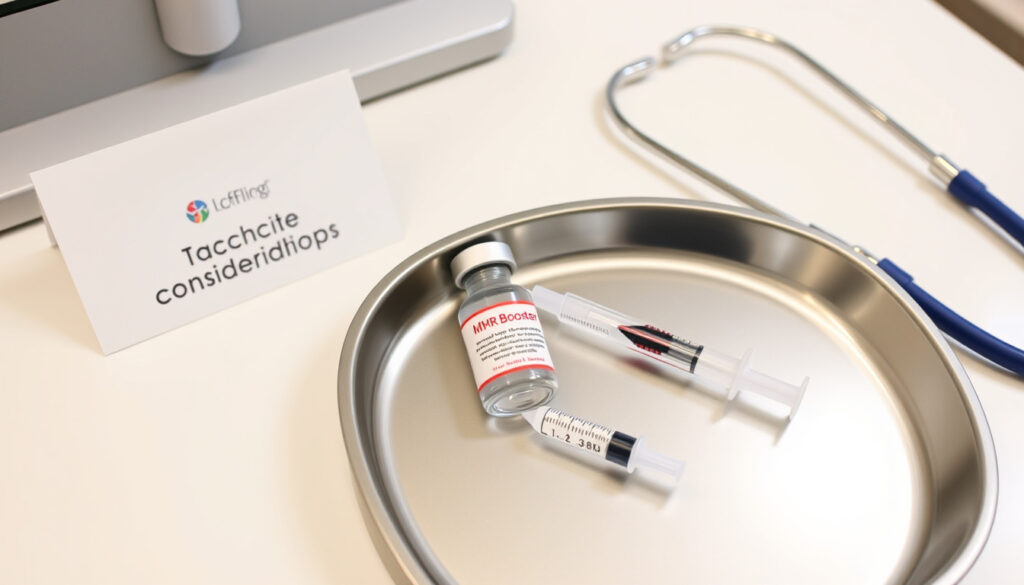
Measles Vaccine Booster: Should Adults Get Another Dose
You might remember getting the MMR shot as a kid — but if you’re an adult born between 1957 and 1989, the question of whether you need another dose isn’t always straightforward. With measles outbreaks flaring up in 2024, many are wondering if their childhood vaccine still holds up.
This guide lays out exactly what the CDC says, how to check your immunity, and when a booster might make sense.
Two-dose effectiveness: 97% ·
First vaccine licensed: 1963 ·
Protection after first dose: over 90% ·
Common side effects: fever, rash ·
Countries with ongoing outbreaks: multiple in 2024
Quick snapshot
- Two doses of MMR provide lifelong protection for most people (CDC vaccine guidelines)
- Measles is one of the most contagious known diseases (WHO fact sheet)
- Duration of protection in adults who received only one dose (Cleveland Clinic Journal of Medicine)
- Exact antibody threshold needed for protection (Cleveland Clinic Journal of Medicine)
- First vaccine licensed in 1963 (CDC historical notes)
- Two-dose schedule recommended since 1989 (CDC vaccination schedule)
- Ongoing booster campaigns in outbreak areas (AAP News)
- Travel advisory updates for affected countries (CDC travel guidance)
Six key facts, one pattern: the measles vaccine is highly effective, but gaps in adult coverage persist.
| Attribute | Detail |
|---|---|
| Vaccine Type | MMR (live attenuated) |
| Number of Doses | 2 recommended |
| Protection after 2 doses | 97% |
| Common Side Effects | Fever, rash, mild rash |
| First Licensed | 1963 (single), 1971 (combined) |
| Elimination Status (US) | Declared eliminated in 2000 |
The implication: the vaccine is highly effective, but gaps in adult coverage remain.
Do adults need a measles booster?
Should you get a measles vaccine booster?
- The CDC recommends one dose of MMR for most adults who have presumptive evidence of immunity and no high-risk indication for two doses (CDC vaccine recommendations).
- Adults born before 1957 are generally considered immune because measles was widespread before the vaccine (CDC background).
- A booster may be needed for international travel, healthcare work, or during an outbreak (CDC risk groups).
The implication: for most adults, one dose is fine — but if you fall into a high-risk category, a second dose is recommended.
The pattern: risk is driven by exposure, not age alone.
When did they start vaccinating for measles?
History of measles vaccine development
- First measles vaccine licensed in 1963 (Edmonston B strain) (CDC vaccine history).
- MMR combined vaccine introduced in 1971 (CDC MMR timeline).
- Two-dose schedule recommended in the US since 1989 (Cleveland Clinic Journal of Medicine).
What this means: if you were vaccinated between 1963 and 1989, you likely received only one dose — and that may matter for your protection level today.
Can older adults get measles again?
Measles immunity in older adults
- Older adults can contract measles if they were never vaccinated or if immunity wanes (CDC on adult risk).
- People born before 1957 are presumed immune because they likely had the disease (CDC birth year rule).
Waning immunity over time
- Two doses of MMR are 97% effective, but protection may decline slightly in some individuals (CDC effectiveness data).
- Breakthrough infections are mild but can still spread (AAP News report).
Adults born between 1957 and 1989 may have only one dose or uncertain records — and if they travel or work in healthcare, they face a real gap.
The pattern: age alone isn’t the risk — it’s dose number and exposure setting.
How do I tell if I need a measles booster?
How do I know if I’ve had the measles vaccine?
- Check your vaccination card or ask your childhood doctor’s office (CDC record tips).
- If you’re unsure, a blood test for IgG antibodies can confirm immunity (Cleveland Clinic Journal of Medicine).
Checking vaccination records
- Many states have immunization registries — contact your health department (CDC record search).
- If records are lost, the CDC recommends a dose of MMR if you have no proof and are in a risk group (CDC guidance).
Serological testing for measles immunity
- Your doctor can order a measles IgG test (CDC lab info).
- The CDC says after vaccination, it is not necessary to test for antibodies (CDC testing policy).
The trade-off: serology can give peace of mind, but CDC says it’s usually unnecessary if you have good records.
Can I still get measles if I was vaccinated 50 years ago?
Duration of vaccine protection
- Two doses provide long-term protection in most people (CDC long-term data).
- One dose — common before 1989 — may leave some vulnerable after decades (CDC single dose info).
Measles outbreaks in vaccinated individuals
- Breakthrough infections are possible but mild (CDC breakthrough cases).
- The CDC may recommend a booster for those with high exposure risk (CDC outbreak recommendations).
If you were vaccinated before 1989 and only got one dose, you’re not fully protected in an outbreak — and your risk of catching measles, though mild, is real.
The catch: single-dose recipients face a real gap during outbreaks.
Upsides and downsides of the measles vaccine
Upsides
- Extremely effective — 97% with two doses (CDC)
- Lifelong protection for most people (WHO)
- Safe with mild side effects (CDC safety)
Downsides
- Single dose may not be enough for some (Cleveland Clinic Journal of Medicine)
- Rare adverse reactions (e.g., febrile seizures) (NHS)
- Not recommended during pregnancy (CDC pregnancy contraindication)
The pattern: the vaccine is highly effective, but the single-dose limitation is a key gap.
Steps to check your measles immunity and get vaccinated
- Find your vaccination records or check your birth year — if before 1957, you’re likely immune.
- If you were born 1957‑1989 and have only one dose, consider a second if you travel or work in healthcare (CDC risk criteria).
- Ask your doctor for a measles IgG blood test if records are missing.
- If no immunity is found, get an MMR dose — the CDC says it’s safe and effective (CDC MMR info).
- During an outbreak, follow local public health orders for additional doses (CDC infection control guidance).
Why this matters: taking these steps can prevent infection and stop the spread.
Timeline: key milestones in measles vaccine history
- 1963 – First measles vaccine licensed (Edmonston B strain) (CDC)
- 1971 – MMR combined vaccine introduced (CDC)
- 1989 – Two-dose schedule recommended in US (CDC)
- 2000 – Measles declared eliminated in the United States (WHO)
- 2019 – Resurgence of measles outbreaks in the US (AAP News)
- 2024 – Ongoing outbreaks in multiple countries, booster campaigns (CBS News)
The pattern: the timeline shows a clear shift from elimination to resurgence.
Clarity: what’s confirmed and what’s still unclear
Confirmed facts
- Two doses of MMR vaccine provide lifelong protection for most people (CDC)
- The vaccine prevents serious disease and death (WHO)
- Measles is highly contagious and can spread before symptoms appear (CDC)
What’s unclear
- Duration of protection in individuals vaccinated only once (Cleveland Clinic Journal of Medicine)
- Risk of waning immunity in older adults without a booster (CDC)
- Exact threshold of antibodies needed for protection (Cleveland Clinic Journal of Medicine)
The evidence strongly supports vaccination, but the fine print about adult boosters is still being studied.
The pattern: the science is strong on vaccination, but the adult booster question remains under study.
Expert perspectives on the measles vaccine
“The best protection against measles is the MMR vaccine.”
— CDC (CDC – Measles Vaccination)
“Measles is one of the leading causes of death among young children worldwide.”
— WHO (WHO)
“Two doses of MMR vaccine give long-lasting protection.”
— NHS (NHS)
Related reading: Priscilla Chan: Pediatrician Turned Philanthropist and Dr. Oz: Career, Controversies, and CMS Role Explained.
Summing it up
The measles vaccine is one of the most effective tools we have. For adults born between 1957 and 1989, the question isn’t about safety — it’s about dose count and exposure risk. If you’re a healthcare worker, an international traveler, or living in an outbreak area, a second dose is a smart move. For others, one dose and clear records are enough.
For adults born between 1957 and 1989, the choice is clear: check your vaccination records and, if you’re in a high-risk group, talk to your doctor about a booster — or risk being unprotected in an outbreak.
cdc.gov, cvs.com, merckvaccines.com, cdc.gov, immunize.org, webmd.com, cdc.gov
For a detailed breakdown of who needs a booster and why, see this comprehensive measles vaccine booster guide from our Canadian colleagues.
Frequently asked questions
What is the MMR vaccine?
The MMR vaccine protects against measles, mumps, and rubella. It’s a live attenuated vaccine given in two doses.
How many doses of measles vaccine are needed?
Two doses are recommended: the first at 12–15 months and the second at 4–6 years. Adults may need one or two doses depending on risk.
Can the measles vaccine cause autism?
No. Numerous studies have found no link between the MMR vaccine and autism. The original study suggesting a link has been retracted.
Is it safe to get the measles vaccine during pregnancy?
No. The MMR vaccine is contraindicated during pregnancy. Women should avoid pregnancy for 28 days after vaccination.
Where can I get the measles vaccine?
You can get the MMR vaccine at your doctor’s office, local health department, pharmacy, or travel clinic.
What should I do if I’m exposed to measles and haven’t been vaccinated?
Contact your doctor immediately. Post-exposure vaccination within 72 hours may prevent infection. If that window passes, immunoglobulin can be given.
Can the measles vaccine be given with other vaccines?
Yes. The MMR vaccine can be given at the same time as other vaccines, such as varicella, but should not be given within 28 days of each other if not simultaneous.
The bottom line: the FAQ answers common questions about MMR safety and scheduling.
More related posts
 Shaun Cassidy: What He’s Doing Now, Family, Net Worth, and More
 Aditya Dhar: Biography, Wife, Dyslexia, and Net Worth
 A Million Little Things: Streaming, True Story & Key Plot Points
 Peter Crouch: Height, Wife, Net Worth & Career
 Janette Bertrand: Biography, Age, and Lasting Legacy
 Mehdi Hasan: Cancelled, Credibility, and New Media Venture
 Sarah Michelle Gellar: Biography and Facts
 Ahn Hyo-Seop: Bio, Dating, Military Exemption & Dramas